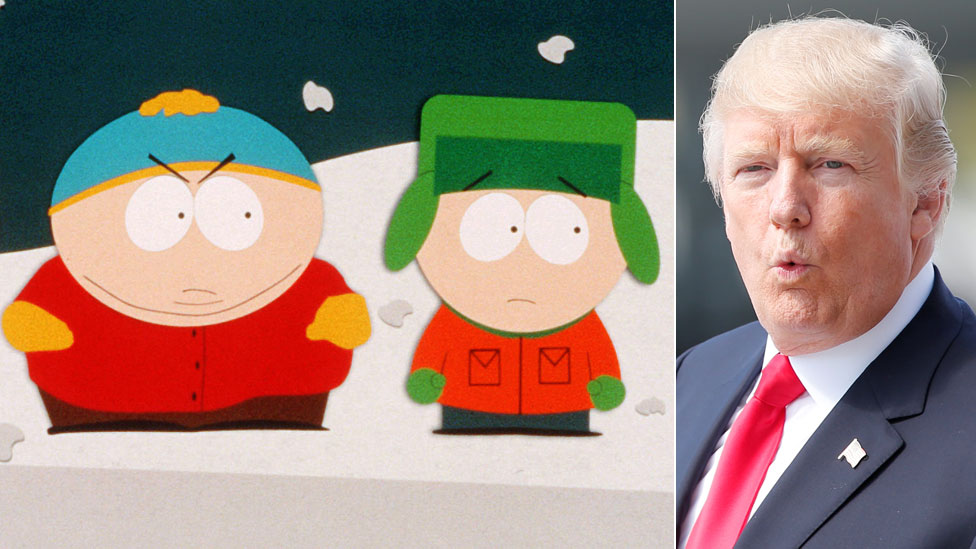
The creative minds behind South Park, Trey Parker and Matt Stone, have once again stirred attention with a characteristically irreverent response involving former U.S. President Donald Trump. Known for their sharp satire and fearless commentary on political and cultural figures, Parker and Stone used their platform to deliver what appeared to be a tongue-in-cheek “apology” that, true to form, was layered with irony rather than contrition.
Through the years, South Park has earned a name for itself by directly addressing controversial topics, frequently balancing between humor and analysis. The series has consistently aimed to underscore the ridiculousness of actual events by employing exaggerated comedy and sharp observations. Their most recent engagement with the Trump storyline maintains this practice, presenting viewers with another instance of how satire can both entertain and provoke thought.
The so-called apology came in the form of a mock statement—crafted with the same tone and style that fans of the series have come to expect. Rather than issuing a sincere expression of regret, Parker and Stone used the moment to reflect on the current media climate and public discourse, particularly surrounding figures as polarizing as Trump. The statement was framed not as a genuine retraction, but rather as a layered commentary on outrage culture, public backlash, and the complex relationship between entertainment and politics.
During the series’ progression, Donald Trump was frequently featured. The individual known as “Mr. Garrison” acted as an unmistakable satire of Trump during the 2016 elections and afterwards. The creators utilized this narrative to tackle wider issues related to leadership, populism, and societal response. Their depiction wasn’t meant to support or vilify, but to highlight the contradictions and dramatic elements inherent in today’s political realm.
In this most recent instance, the creators’ message seemed less about Trump himself and more about the performative nature of public apologies in today’s media landscape. The language used mimicked that of corporate or celebrity apologies—carefully crafted, publicly shared, and often scrutinized more for their tone than their content. Parker and Stone used this familiar structure to deliver a message that was, at its core, a critique of the performative apology trend that has permeated both political and entertainment spheres.
By presenting their message as an “apology,” the South Park creators introduced an additional aspect to their satire: the implication that in modern culture, even humor needs to proceed with caution. The irony was clear to viewers, many of whom noticed the intentional imitation of public relations language and the deeper discussion on censorship, freedom of expression, and the limits of satire.
Parker and Stone have consistently resisted efforts to censor their content or soften their tone, even in the face of significant backlash. Their creative philosophy emphasizes pushing the envelope and confronting difficult issues through humor, even when that humor makes viewers uncomfortable. It is this unapologetic stance that has earned them both praise and criticism, and their latest gesture is another reminder of their unwillingness to conform to external expectations.
The reaction from the creators further emphasized their long-standing conviction that humor is essential for critiquing society. They believe that humor has the power to confront those in power, stimulate reflection, and reveal insincerities. By highlighting the dynamics of contemporary conversations—particularly the inclination to call for retractions or apologies due to contentious material—they motivate viewers to not only scrutinize the content they watch but also examine their responses to it.
This dynamic between South Park and its audience has evolved over the years. What began as a crass animated series targeting juvenile humor has matured into a platform for sophisticated, if abrasive, cultural commentary. The show’s ability to provoke discussion while maintaining its irreverent edge is part of what has kept it relevant for more than two decades.
In lampooning both Trump and the culture that surrounds him, Parker and Stone are less interested in making political statements and more focused on exposing the mechanics of influence, power, and media consumption. Their comedy doesn’t ask audiences to take sides—it asks them to pay attention, to laugh at the absurdity, and to think critically about the systems that shape public opinion.
While some viewers may find the creators’ style offensive or inappropriate, others see it as a necessary antidote to the sanitized narratives often presented in mainstream media. The tension between these perspectives is exactly where South Park thrives, occupying a space where discomfort and comedy coexist, and where satire serves as both entertainment and interrogation.
The simulated apology aimed at Trump continues this tradition—a performative gesture designed not to mend but to mirror. It prompts the audience to ponder not just the target of the humor, but also the essence of the joke, the context of its creation, and the demands on creators in a period of increased awareness.
Parker and Stone have showcased their expertise in satire, employing humor to not only comment on political personalities but also the cultural environment surrounding them. Regardless of whether one concurs with their style, their output continues to be a stimulating influence in contemporary media—persistently vocal and uncompromising in presenting their unabridged viewpoint.