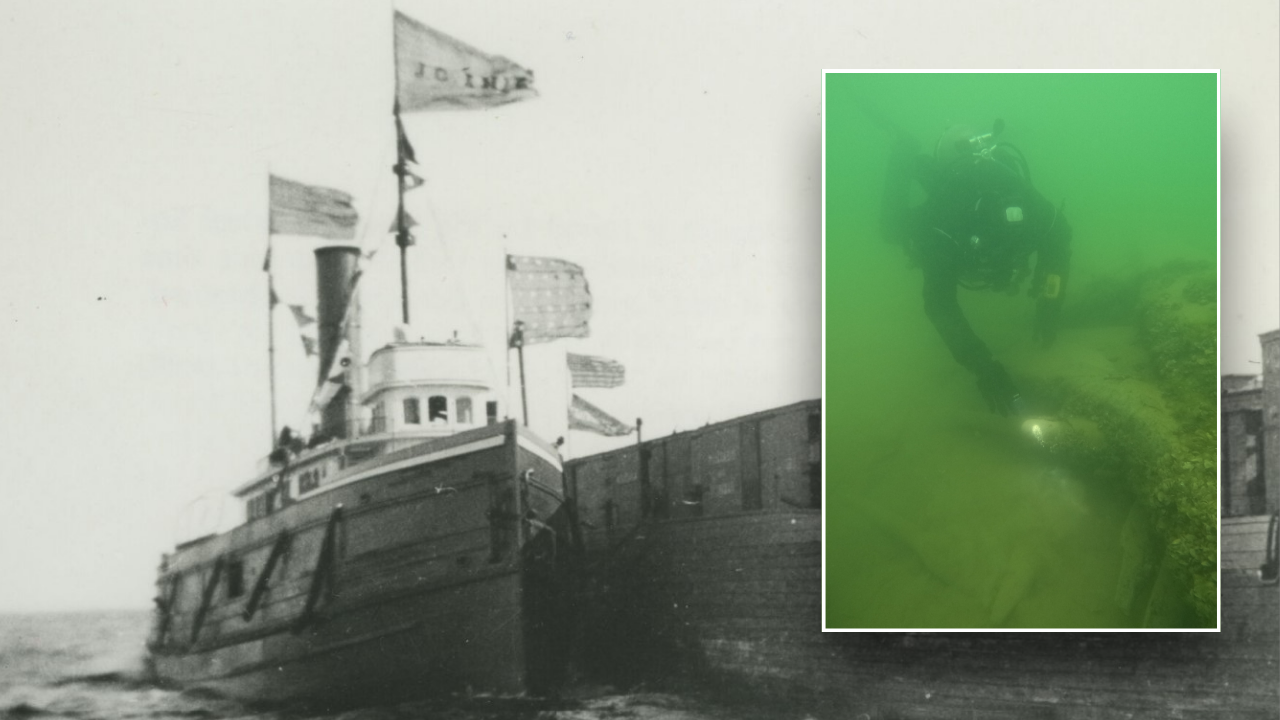
What began as an ordinary day on the water for a Wisconsin boating enthusiast turned into an extraordinary discovery that has captured the attention of historians, divers, and maritime enthusiasts across the country. Beneath the calm surface of Lake Michigan, a relic of the past had been resting silently for decades—until a chance encounter brought it back into the spotlight.
The Great Lakes have long been known for their rich maritime history. Over the centuries, thousands of ships have sailed across these vast waters, carrying cargo, passengers, and dreams of prosperity. However, the same waters that sustained trade and transportation also concealed their share of tragedies, claiming vessels during fierce storms and unpredictable conditions. Many of those ships were never seen again—until now.
An unexpected encounter on a routine outing
The boater, who wishes to remain anonymous for now, set out for a quiet day of fishing on Lake Michigan, one of the five Great Lakes and the only one entirely within the United States. Known for its vast expanse and sometimes treacherous waters, the lake has been both a lifeline and a graveyard for countless ships over the centuries.
On this specific occasion, the weather was perfect—blue skies, tranquil waters, and a gentle breeze moving across the surface. Employing advanced sonar technology to find groups of fish, the sailor observed something unexpected on the screen. Rather than the usual clusters of fish or natural objects, the display showed a clear, long shape resting on the lake floor.
Intrigued, the sailor chose to explore more deeply. After accurately pinpointing the spot and deploying a submerged camera, the display started to unveil something remarkable: the outline of an undamaged wooden craft, including masts and additional structural elements, indicating it was an ancient vessel.
A window into maritime history
For a long time, specialists have believed that numerous shipwrecks lie unseen beneath Lake Michigan’s waters, with many of them originating from the 19th and early 20th centuries when the Great Lakes functioned as significant trade routes. The recently found vessel seems to correspond to the features of ships from that period, presenting a rare chance for researchers to analyze a remarkably well-preserved piece of maritime history.
Preliminary evaluations indicate that the shipwreck might be that of a schooner, a type of sailing ship commonly employed in the 19th century to move timber, grain, and various products. Such vessels were crucial for the economic growth of the Midwest, traversing the extensive system of lakes and rivers to link inland localities with key marketplaces.
The cold freshwater setting of the Great Lakes is renowned for its ability to maintain shipwrecks much more effectively than salty waters, where creatures such as shipworms tend to damage wooden vessels as time passes. Consequently, numerous shipwrecks found in this area are remarkably well-maintained, frequently with goods and personal items remaining fully preserved.
The enigma surrounding the submersion
While the exact identity of the vessel remains uncertain, maritime historians have already begun compiling a list of candidates based on known shipwreck records. Several schooners were reported lost in the late 1800s during violent storms that struck Lake Michigan without warning. At the time, weather forecasting was rudimentary, and sailors often had little advance notice of approaching gales.
A hypothesis proposes that the recently uncovered vessel might have sunk in one of these notorious tempests. Over the years, the Great Lakes have taken countless lives, developing a reputation as some of the most erratic and perilous inland bodies of water globally. The large expanse of the lake and its changing atmospheric conditions can produce waves comparable to those found in the open sea, challenging even the most seasoned sailors.
Further exploration of the wreck will likely provide vital clues. Researchers hope to find inscriptions, cargo remnants, or personal belongings that can help identify the ship and shed light on the circumstances of its sinking. Every detail recovered will contribute to a broader understanding of the region’s maritime history.
Modern technology reveals hidden treasures
This discovery underscores the growing role of technology in uncovering historical artifacts. Just a few decades ago, locating a shipwreck in the vast expanse of Lake Michigan would have been nearly impossible without years of dedicated searching. Today, advancements in sonar imaging, GPS mapping, and underwater drones have revolutionized the field of marine archaeology.
The boater’s application of sonar to identify the unusual object shows that even leisure equipment can result in important discoveries. It is anticipated that expert divers and archaeologists will soon perform thorough examinations of the location, using high-definition imaging to chart the wreck and evaluate its status before any physical actions are undertaken.
Preservation remains a top priority. While the temptation to retrieve artifacts is strong, experts emphasize that disturbing the wreck could cause irreversible damage. Instead, the goal is to document the site thoroughly and, if possible, designate it as a protected cultural resource under state and federal regulations.
Why shipwrecks matter to our shared history
Beyond their visual appeal and sense of mystery, shipwrecks serve as time capsules, preserving snapshots of life from bygone eras. Every vessel tells a story—not just of commerce and navigation, but of the people who built, sailed, and sometimes perished aboard them. These underwater sites offer unparalleled insights into technological advances, trade patterns, and cultural exchanges of their time.
For local communities, such discoveries also carry an emotional and educational value. Museums across the Great Lakes region regularly feature exhibits on shipwrecks, drawing visitors eager to learn about the perils and triumphs of maritime history. This latest find is expected to attract significant interest, potentially boosting heritage tourism and inspiring new research initiatives.
Authorities and maritime specialists are currently planning the following procedures, which involve a detailed analysis of the shipwreck’s architecture, material makeup, and its surroundings. The aim is to identify optimal methods for conservation and research without compromising the site’s integrity.
Should the ship be positively recognized, it might be added to the official list of historic shipwrecks in the Great Lakes. This status would guarantee lasting preservation and might create possibilities for virtual explorations, 3D mapping initiatives, and educational schemes.
Regarding the sailor who accidentally found the shipwreck, their surprising involvement in this find highlights that history frequently conceals itself in obvious places—awaiting the perfect mix of inquisitiveness, technology, and luck to reveal it.
What lies beneath the waters of Lake Michigan remains a source of wonder, and each new discovery reinforces the profound connection between the past and the present. In the silent depths where time seems frozen, stories of courage, tragedy, and resilience continue to echo, inviting us to explore, learn, and preserve.