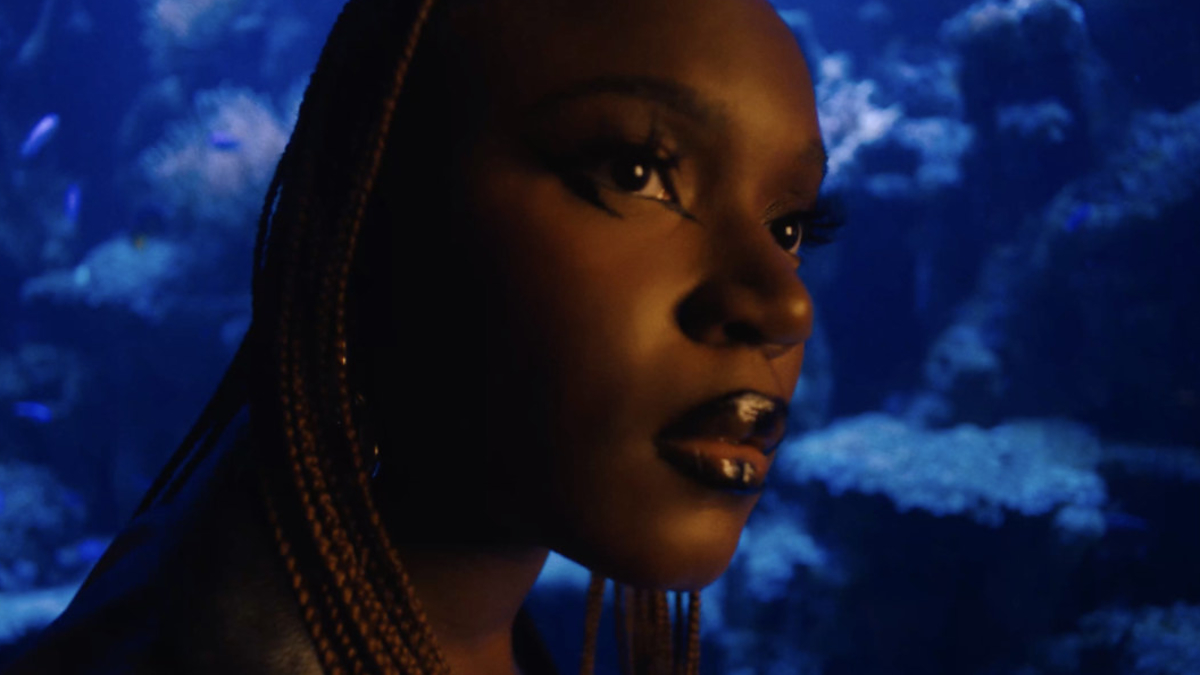
The Ghanaian-American artist Amaarae has emerged as one of contemporary music’s most innovative voices, consistently challenging conventional genre boundaries with her distinctive sound. Her newest album, Black Star, represents both an artistic evolution and a bold statement about creative independence in an industry that often demands categorization.
Born Ama Serwah Genfi, the artist known for singing, songwriting, and producing has created a musical approach that skillfully merges aspects of Afropop, R&B, alternative rock, and electronic music. Her decision to defy typical genre boundaries has distinguished her artistic output. “Being confined to a category never resonated with my creative vision,” Amaarae elaborates. “Music is ever-changing, and I aim for my creations to mirror that changeability—the manner in which we genuinely encounter sound in reality.”
Black Star builds upon the foundation laid by her critically acclaimed 2020 debut The Angel You Don’t Know, while venturing into even more experimental territory. The album’s title pays homage to her Ghanaian heritage—the black star being a central symbol in the nation’s flag and identity—while also signaling her celestial ambitions for the project’s reach and impact.
Amaarae describes the album as her most personal work to date, incorporating influences from her childhood in Accra, her adolescence in Atlanta, and her current perspective as a global artist. The recording process spanned multiple continents, with sessions in Ghana, Nigeria, London, and Los Angeles allowing her to collaborate with diverse producers and musicians.
“This album forced me to dig deeper into my own story while also thinking about music on a global scale,” she says. “I wanted to make something that felt true to my experiences but could also resonate with listeners from completely different backgrounds.”
The musical arrangements on Black Star showcase Amaarae’s growth as a producer. Tracks shift seamlessly between pulsing Afrobeats rhythms, moody alt-R&B grooves, and unexpected rock-inflected guitar lines. Her airy, androgynous vocals float effortlessly over these genre-blurring backdrops, creating a sound that feels both futuristic and rooted in tradition.
Amaarae’s unwillingness to fit into predefined categories has sometimes posed difficulties in a sector that depends significantly on genre labels for promotion and airplay. “In the beginning, there were certainly times when executives would ask, ‘This sounds fantastic, but what exactly is it? How should it be classified?'” she reflects. “However, I have always held the view that if the music is compelling enough, it will reach its listeners, no matter the efforts to categorize it.”
This philosophy appears to be proving correct. Despite—or perhaps because of—its genre defiance, Black Star has garnered attention across multiple music scenes. The album’s lead single became an unexpected hit on both Afropop playlists and alternative radio stations, while the accompanying visual aesthetic (a mix of cyberpunk imagery and West African motifs) has sparked conversations in both fashion and contemporary art circles.
Amaarae’s work exemplifies what some critics have called “Afrofuturism 2.0″—art that acknowledges African traditions while imagining bold new possibilities for the continent’s cultural exports. “Growing up between Ghana and the U.S. gave me this dual perspective,” she explains. “I never saw African music as something separate from global pop. It’s all part of one continuum.”
This perspective is evident all over Black Star. One song could include a traditional highlife guitar melody, while another blends in distorted 808s more frequently linked to trap music. The lyrics transition among English, Pidgin, and Twi, capturing the multilingual experience of numerous young Africans today.
Amaarae’s success comes at a moment when African musicians are experiencing remarkable global exposure. Nonetheless, she warns about considering this as a fleeting trend. “What we’re witnessing is not an unexpected revelation of African talent,” she comments. “The foundation has been laid for many years. The distinction now is that we possess greater influence over how our narratives are shared.”
This oversight is crucial to Amaarae’s method. She takes an active role in all facets of her profession, from producing to visual leadership. For Black Star, she gathered a team of creatives mainly consisting of African women and individuals from the diaspora, guaranteeing a genuine portrayal of her ideas.
While Black Star isn’t an explicitly political record, Amaarae recognizes that her presence as an androgynous, boundary-pushing African woman in the music scene holds meaning. “In certain contexts, simply being authentic can have an impact,” she notes. “I’m not intentionally creating political works, though I realize that for some audiences, witnessing someone like me succeed here seems groundbreaking.”
This subtle wave of silent defiance flows throughout the album’s lyrics, addressing themes of self-reliance, sexual liberation, and the intricacies of cultural identity. Amaarae’s lyricism harmonizes these profound subjects with witty language and captivating tunes, crafting music that is both intellectually stimulating and strikingly hip.
With Black Star receiving widespread critical acclaim, Amaarae finds herself at an interesting crossroads. The album’s success proves there’s an audience for her boundary-pushing approach, but the music industry remains notoriously resistant to artists who defy easy categorization.
“I’m not worried about it,” she says with characteristic confidence. “The world is changing. Listeners today have access to everything at once—they might stream an Afrobeats track, then a punk song, then some experimental electronic thing. My music reflects that reality.”
In terms of future plans, Amaarae suggests a potential involvement in film scoring and fashion design, although music continues to be her main priority. “Currently, I’m simply savoring this period,” she mentions. “It was a lengthy process to create something that genuinely reflected all my inspirations, and to see people resonating with it is incredible.”
Something appears to be clear: no matter what path Amaarae’s career follows next, it will not be limited by assumptions or genre restrictions. In a time when music is becoming more uniform, her dedication to artistic liberty is both invigorating and essential. Black Star not only signals Amaarae’s emergence as a significant performer but also hints at thrilling opportunities for the future direction of worldwide pop music.
The album acts as both an individual expression and a wide-ranging reflection on the progression of art in today’s digital era. With streaming and social platforms continually dissolving geographical and stylistic boundaries, musicians such as Amaarae—who skillfully integrate elements from the African diaspora and further—might indeed symbolize the direction of mainstream music.
For those listeners seeking a break from conventional patterns and excited for authentic innovation, Black Star provides an exciting look at the results when an artist fully commits to creative liberty. As Amaarae herself expresses: “The boundaries never existed, to begin with. I’m simply creating the music that resonates in my mind.”
As the music industry continues evolving, one suspects more artists will follow her lead, creating work that transcends traditional categories in favor of something more fluid, more personal, and ultimately more interesting. In this context, Black Star feels less like an anomaly and more like a sign of things to come—a bright light pointing toward pop music’s boundless future.