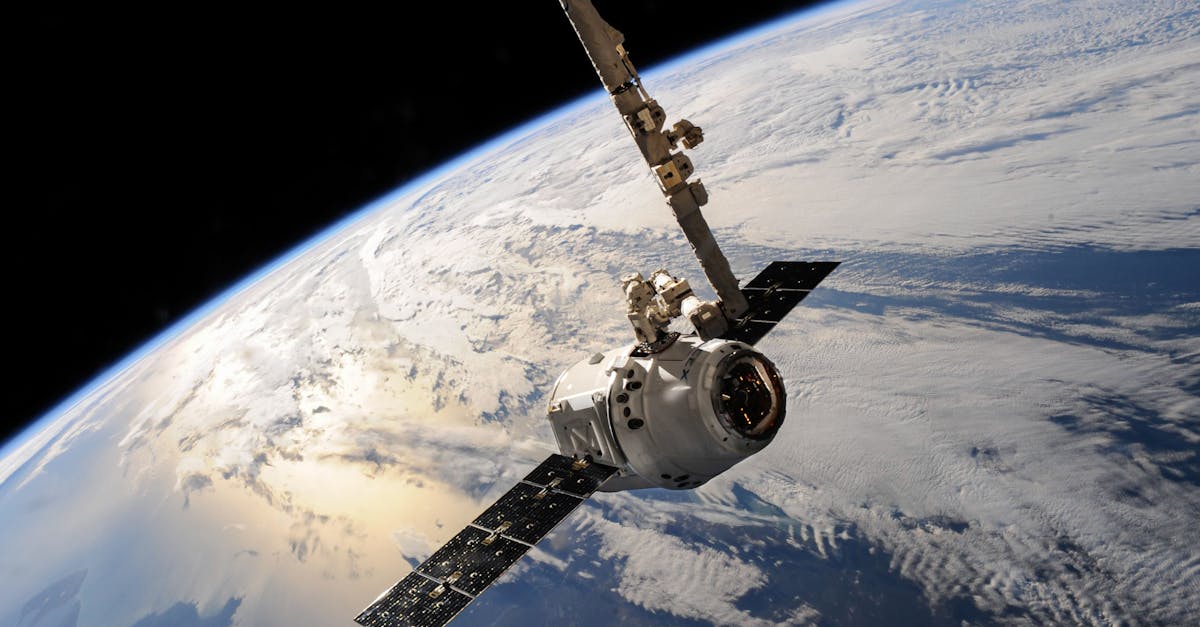

1. Hubble Space Telescope (HST)
Deployed in 1990, the Hubble Space Telescope revolutionized contemporary astronomy by operating outside Earth’s atmosphere, thereby removing atmospheric interference. Featuring a 2.4-meter primary mirror alongside instruments capable of detecting visible, ultraviolet, and near-infrared radiation, Hubble has accumulated upwards of 1.5 million scientific observations.
Key achievements include:
- Accurate determination of how fast the cosmos expands.
- Deep field snapshots uncovering thousands of remote galaxies.
- Data indicating that colossal black holes reside at galactic cores.
Hubble’s long lifespan and maintenance operations transformed it into one of the most scientifically fruitful devices ever created.
2. James Webb Space Telescope (JWST)
Launched back in 2021, the James Webb Space Telescope stands as the most potent space observatory ever built. Thanks to its 6.5-meter segmented mirror and infrared capabilities, it is able to pierce through cosmic dust and examine the earliest galaxies that formed more than 13 billion years ago.
Its innovations include:
- A five-layer sunshield the size of a tennis court.
- Operation at temperatures below 50 Kelvin.
- Unprecedented sensitivity to exoplanet atmospheres.
JWST has already identified some of the most distant galaxies known and detected chemical signatures such as water vapor and carbon dioxide in exoplanet atmospheres.
3. Extremely Large Telescope (ELT)
Currently under construction in Chile, the Extremely Large Telescope will feature a 39.3-meter primary mirror composed of 798 hexagonal segments. It will be the largest optical and near-infrared telescope ever built.
With advanced adaptive optics correcting atmospheric turbulence in real time, the ELT aims to:
- Directly image Earth-like exoplanets.
- Study black holes in unprecedented detail.
- Analyze the chemical evolution of distant galaxies.
Its resolving power will exceed that of Hubble by more than 15 times.
4. Keck Observatory Telescopes
Located in Hawaii, the twin Keck telescopes each have a 10-meter segmented mirror. Operational since the 1990s, they pioneered adaptive optics for ground-based astronomy.
Major contributions include:
- Tracking stars orbiting the Milky Way’s central black hole.
- Characterizing distant supernovae used to measure dark energy.
- Confirming thousands of exoplanets.
Their mix of scale and responsive systems has kept them at the cutting edge of exploration for generations.
5. Very Large Telescope (VLT)
Managed by the European Southern Observatory in Chile, the Very Large Telescope comprises four 8.2-meter instruments capable of functioning separately or combining as an interferometer.
The VLT features:
- Captured the first direct image of an exoplanet.
- Tracked stars near a supermassive black hole, confirming Einstein’s predictions.
- Produced detailed spectra of early-universe galaxies.
Its interferometric mode achieves angular resolution equivalent to a much larger single telescope.
6. Atacama Large Millimeter/submillimeter Array (ALMA)
ALMA is not a single telescope but a network of 66 high-precision antennas in Chile’s Atacama Desert. Observing millimeter and submillimeter wavelengths, ALMA excels at studying cold cosmic objects such as molecular clouds and protoplanetary disks.
Key attractions comprise:
- Imaging planet-forming disks with striking clarity.
- Mapping molecular gas in distant galaxies.
- Detecting complex organic molecules in space.
Its high-altitude location at 5,000 meters minimizes atmospheric interference.
7. Thirty Meter Telescope (TMT)
The Thirty Meter Telescope, scheduled to be built in the Northern Hemisphere, is set to incorporate a 30-meter segmented mirror. Engineered for both optical and infrared bands, it is intended to work alongside the ELT.
Expected capabilities:
- Imaging exoplanets located close to brilliant stars.
- Examining how the earliest galaxies formed.
- Analyzing the distribution of dark matter.
Once operational, it will provide spatial resolution twelve times sharper than Hubble.
8. Giant Magellan Telescope (GMT)
The Giant Magellan Telescope, under construction in Chile, will combine seven 8.4-meter mirrors to create an effective aperture of 24.5 meters.
Its scientific goals include:
- Detecting biosignatures in exoplanet atmospheres.
- Studying stellar populations in distant galaxies.
- Exploring the physics of black holes.
Advanced adaptive optics will enable images ten times sharper than those from current large ground-based telescopes.
9. Arecibo Observatory
Before its collapse in 2020, the Arecibo Observatory in Puerto Rico was the world’s largest single-dish radio telescope, with a 305-meter diameter reflector.
Its legacy includes:
- The first indirect evidence of gravitational waves via pulsar timing.
- Mapping near-Earth asteroids.
- Sending the famous interstellar radio message in 1974.
Arecibo’s immense collecting area made it uniquely powerful for radio astronomy and planetary radar studies.
10. Five-hundred-meter Aperture Spherical Telescope (FAST)
Situated in China, the FAST telescope currently holds the title of the globe’s biggest filled-aperture radio telescope, boasting a 500-meter dish.
Its strengths include:
- Unearthing hundreds of novel pulsars.
- Delving into fast radio bursts.
- Executing deep surveys targeting neutral hydrogen.
FAST’s sensitivity surpasses Arecibo’s, enabling detection of extremely faint cosmic radio sources.
The Expanding Horizon of Cosmic Vision
From Hubble’s revolutionary orbiting eye to JWST’s infrared precision and the colossal mirrors rising in Chile, each of these telescopes represents a leap in humanity’s ability to observe the universe. Power in astronomy is measured not only by mirror size or dish diameter, but by sensitivity, resolution, wavelength coverage, and technological ingenuity. Together, these instruments have revealed black holes, mapped dark matter, traced cosmic history back to its earliest epochs, and identified planets orbiting distant stars. As even larger and more advanced observatories come online, the boundary between the known and the unknown continues to shift, reminding us that every technological breakthrough expands both our scientific knowledge and our sense of place in the cosmos.