With the government shutdown entering its second month, the Federal Aviation Administration (FAA) has declared a reduction in flights across several of the country’s most active airspaces. This decision arises from increasing worries regarding personnel deficits and exhaustion among air traffic controllers, who have been operating without compensation.
Transportation Secretary Sean Duffy confirmed that beginning this Friday, air traffic capacity will be cut by 10% at approximately 40 airports across the country. According to Duffy, the decision aims to alleviate mounting pressure on critical areas of the aviation network. “This is about identifying where the strain is and taking steps to relieve it,” he said during a press briefing.
FAA Administrator Bryan Bedford explained that the reduction in flight capacity stems from the need to address fatigue among air traffic controllers, many of whom have continued to work tirelessly despite the financial and emotional toll of the ongoing shutdown. The list of affected airports is expected to be released shortly, and the measure will be implemented gradually — beginning with a 4% reduction in flights on Friday, 5% on Saturday, and reaching the full 10% by next week.
Mounting delays and growing concerns
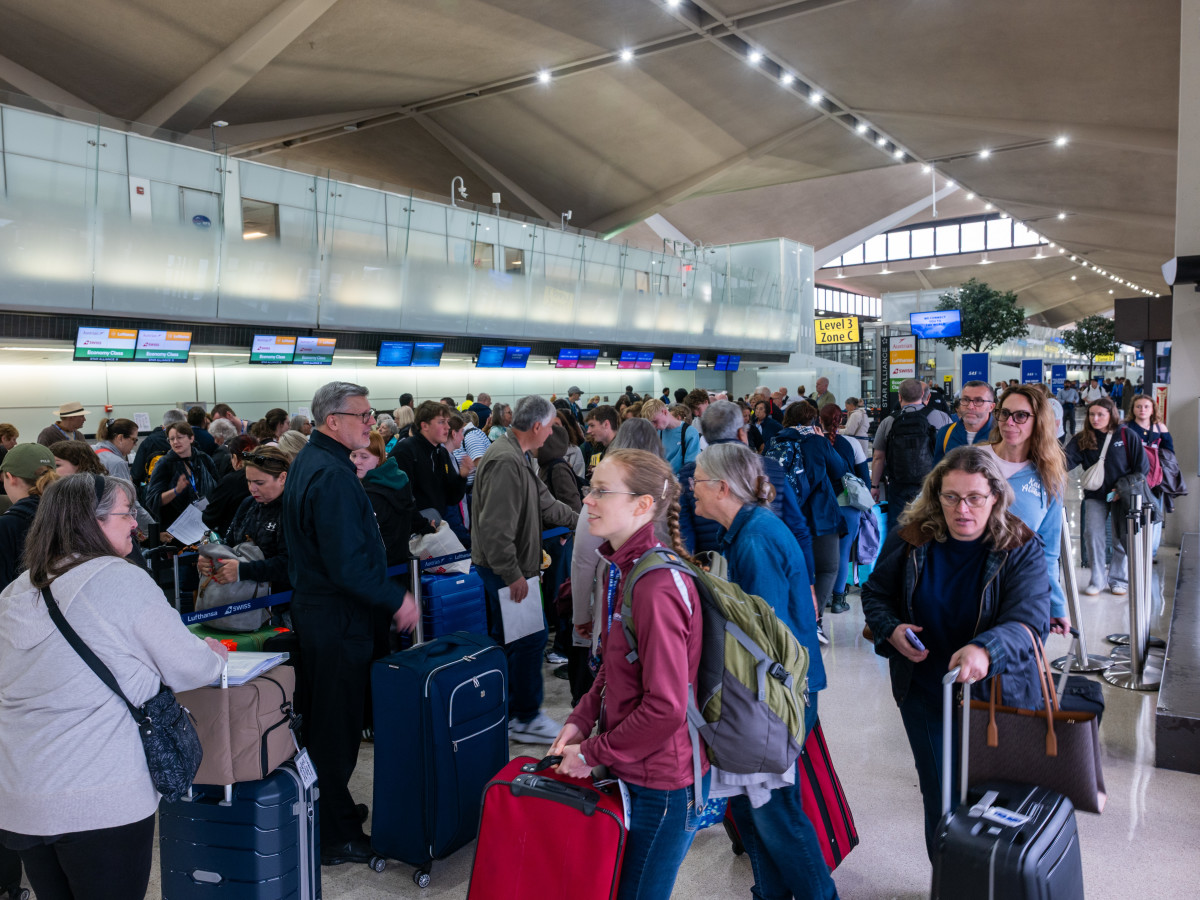
The declaration comes after a tumultuous time for American air travel, as thousands of travelers have already faced interruptions due to insufficient personnel. This past weekend, over 5,000 flights across the country were postponed, with significant centers like Chicago O’Hare, Newark Liberty, JFK, and Hartsfield-Jackson Atlanta International Airport experiencing the most profound effects.
Data from FlightAware indicated that on Monday, almost 2,900 flights experienced delays, and 70 cancellations were recorded. By Tuesday, the number of cancellations had surged to 148, while delays still exceeded 2,000. As of Wednesday night, more than 2,100 flights were delayed and 164 canceled on both domestic and international itineraries. Although FlightAware does not detail the reasons for each delay, authorities confirmed that the staffing shortage resulting from the shutdown has been a significant contributor.
Transportation Secretary Duffy cautioned the public to anticipate “considerable interruptions” in air travel, particularly with the upcoming holiday period. During a television appearance, he clarified that the absence of compensation for air traffic controllers has created an untenable circumstance. “Should the shutdown persist until Thanksgiving, conditions will be quite challenging,” Duffy stated. “We will strive to uphold safety standards, but ensuring punctual departures and arrivals will become increasingly difficult.”
He additionally voiced apprehension that certain controllers have been compelled to undertake supplementary employment to fulfill their monetary commitments, thereby intensifying their exhaustion. “They’re doing what’s necessary to get by,” he remarked. “We desire their full attention and presence, yet we cannot disregard the fact that they’ve endured weeks without compensation.”
Tiredness and security when stressed
FAA Administrator Bedford emphasized that the agency cannot wait for the situation to deteriorate further before taking action. “We’re already seeing the effects of fatigue in the system,” he said. “Controllers have been operating under extreme stress, and it’s beginning to show.”
According to Bedford, the FAA is taking proactive steps to prevent a decline in safety standards. “We can’t ignore the signs of strain,” he said. “Reducing flight volume is a temporary but necessary measure to ensure that we maintain control of the airspace safely.”
The deficit of air traffic controllers is estimated to be between 2,000 and 3,000 roles, a figure that keeps expanding as the closure persists. Although critical staff must report for work without compensation, the extended financial instability has exerted unparalleled strain on the employees.
Officials indicated that additional measures could follow if the situation does not improve. “We’re monitoring this hour by hour,” Bedford said. “If the pressure persists, we will take further steps to maintain system stability.”
Airlines brace for turbulence
Airlines have started modifying their operations in preparation for the FAA’s planned capacity reductions. United Airlines’ chief executive, Scott Kirby, informed staff that regional and domestic flights not linked to primary hubs would experience the most significant impact. Nevertheless, he guaranteed that long-distance international services and flights between hubs would largely remain unchanged to safeguard scheduling reliability and crew management.
Kirby further mentioned that travelers who would rather avoid flying at this time are eligible to ask for a reimbursement, even if their specific flight has not been called off. Notwithstanding the cutbacks, United and its associated regional carriers anticipate conducting roughly 4,000 flights daily.
American Airlines issued a statement indicating that it expects minimal disruption to its customers’ travel plans, emphasizing that the majority of flights should continue as scheduled. Meanwhile, Airlines for America, an industry trade group, said it is working closely with the federal government to clarify the details of the reduction plan and minimize its impact on passengers and cargo shipments.
The Department of Transportation has been working closely with airline officials to guarantee a structured implementation of the updated flight timetable. “Our goal is an orderly deployment,” stated Bedford, mentioning that the FAA and airline leadership convened on Wednesday evening to finalize the operational specifics.
Impact on passengers and the broader economy
The ripple effects of the FAA’s decision are expected to extend beyond passengers to include airline revenue, tourism, and cargo logistics. The aviation sector plays a critical role in maintaining the country’s economic momentum, and prolonged disruptions could have far-reaching consequences.
Travel analysts warn that if the government shutdown continues, the strain on the air travel system could worsen. Longer wait times, last-minute cancellations, and more frequent delays may become the norm, especially during peak travel periods such as Thanksgiving and Christmas.
The Transportation Security Administration (TSA) is confronting increasing difficulties, as its personnel processed approximately 2.7 million travelers last Sunday—a figure representing one of the highest passenger counts recorded since the government closure began. Despite their unwavering commitment, numerous TSA staff members are performing their duties without compensation, which further intensifies the systemic strain on the United States’ aviation framework.
A call for resolution
Secretary Duffy and Administrator Bedford emphasized that the decrease in flights is not intended as a punitive measure but rather as a protective step to ensure the system’s stability. They highlighted that the resumption of complete air traffic services is contingent upon the resolution of the shutdown and the restoration of standard funding.
When questioned about the immediate resumption of standard flight capacity following the shutdown’s conclusion, Bedford responded with prudence: “We must observe air traffic controller performance levels that align with those prior to the shutdown before we can fully scale operations back up.”
As of now, no timeline has been given for when regular operations might resume, but officials remain hopeful that a swift political resolution could prevent deeper disruptions.
In the meantime, passengers are encouraged to stay informed through airline communication channels and plan for possible changes in their travel schedules. While the FAA’s measures aim to preserve safety amid challenging circumstances, the episode highlights how dependent modern air travel has become on the people who manage its complex and demanding systems.